Apprenticeships
Apprenticeships
Semester is an independent training provider, approved on the Apprenticeship Provider and Assessment Register (APAR). We are approved to:
Deliver apprenticeship training to employers that pay the apprenticeship levy, for any apprenticeships that started on or after 1st May 2017.
Deliver apprenticeship training as a subcontractor for any apprenticeships that started on or after 1st May 2017.

More time in work being productive
Apprenticeships are typically run over 18 – 42 months in the workplace. When Semester: Learning and Development manage your apprenticeship the benefits can be easily measured. Your apprentice will spend more time in work being productive, spend less time travelling, spend less costs on accommodation and your business will be getting a better return on your investment than if they went to a bricks and mortar college.

This is made possible by our use of distance learning coupled with our up to the minute Learning Management System (LMS). We offer flexible start times, so you are not restricted to college term dates. Also there are no minimum numbers, you can have as few as 1 apprentice.
Approved Standards
We are approved to offer the following Apprenticeship Standards:
- Welder (ST0349) – Level 2
- Construction Equipment Maintenance Mechanic (ST0805) – Level 2
- Engineering Fitter (ST0432) – Level 3
- Engineering Manufacturing Technician (ST0841) – Level 4
Key Changes for Employers in April 2026
- Apprentice minimum wage increases to £8 per hour
Key Changes for Employers in August 2026
- Levy payer co-investment spilt changes to 75% / 25% (currently 95% / 5%)
- Full funding will be available for apprentices aged under 25 for non-levy payers (currently available for those under 22)
- Levy top-up funding reduces from 10% to 0%
- Levy funds will expire after 12 months (currently 24 months)
What we can help you with?
Primarily we are a training provider registered on RoATP – our UK provider Registration Number is 10048806. We are registered with Pearson (sometimes called Edexcel or BTEC) and Engineering Training Awards (ETa). All have been approved for distance learning and we use state of the art systems to deliver and track progress.
Planning
We know that if you have never employed an apprentice before, it can be very daunting. We can help with the planning of everything from on-boarding, End Point Assessment, Portfolios, Off the Job Training and any number of issues you may have.


Recruitment
If you’ve never taken on an apprentice before, it’s completely natural to feel unsure about what qualities, experience or potential you should be looking for in applicants. Many employers are surprised by how varied apprenticeship candidates can be, and how different the selection process feels compared to hiring someone who already has industry experience. We can support you right from the beginning.
We provide a ready‑made job description templates that align with National Apprenticeship Service requirements, making it simple to post your vacancy nationally without having to create everything from scratch.
Selecting the right person to join your organisation for a three‑year training programme is a significant decision, and it’s understandable that the responsibility can feel daunting. Because of this, employers often appreciate having guidance and reassurance throughout the recruitment process. We’re here to help lighten that load, offering practical support, clear advice and structured tools so you can focus on choosing a candidate who will become a valuable member of your team.
Wellbeing & Pastoral Support
Learning can be challenging at times, especially when you’re balancing study with work, family, or personal commitments. However, you don’t have to manage everything alone. This section is here to help you stay grounded, supported, and confident throughout your learning journey. Whether you’re progressing through an academic course, completing an NVQ, or working as an apprentice, your wellbeing matters just as much as your coursework.
Looking After Yourself

Staying well is an important part of successful learning. For this reason, we provide guidance on managing stress, staying motivated, and maintaining a healthy balance between study, work, and life. You’ll find practical tips to help you stay organised, create healthy routines, and recognise when you need a break.
In addition, we encourage you to explore strategies that support your physical and mental health, such as taking regular pauses, setting realistic goals, and celebrating your progress along the way.
Mental Health Support
There may be times when you feel overwhelmed or unsure where to turn. If this happens, remember that support is available. We offer confidential guidance and can signpost you to trusted organisations such as NHS services, Mind, and Samaritans. Furthermore, we understand that everyone’s situation is different, so we aim to provide compassionate, personalised advice that respects your circumstances. Whether you need someone to talk to or simply want reassurance, we’re here to help you feel heard and supported.
If You’re Struggling
Challenges at home, work, or in your studies can sometimes make learning feel harder than expected. When this happens, reaching out early can make a real difference. Our team is here to help you navigate difficulties, explore solutions, and regain your confidence. Ultimately, your wellbeing comes first, and we’re committed to supporting you in a way that feels respectful, understanding, and genuinely helpful.
Calculating Off the Job Training (OJT) Time
For the apprenticeship to be valid, there has to be 20% of their working time allocated to the apprenticeship. For calculation purposes only, normal working hours are capped at 30 hours per week, which equates to an average of 6 hours off-the-job per week.
So what does 20% look like:

- A common year has 260 working days, which equates to 520 working days for a 24 month apprenticeship
- The minimum holiday entitlement that an employer must provide to a full-time worker is 28 days per year, which includes Bank Holidays (56 days for a 24 month apprenticeship)
- 520 working days minus 56 holiday days equals 464 days
- For the purposes of calculating off-the-job hours, each day equates to 6 hours
- 464 days @ 6 hrs = 2784 hours
- 20% of 2784 = 557 hours need to be allocated to off-the-job training
Note: Time spent studying Functional Skills does not count towards the 20% off-the-job training.
Wages

Apprentices are entitled to the apprentice rate if they’re either aged under 19 or aged 19 or over and in the first year of their apprenticeship.
Example
An apprentice aged 21 in the first year of their apprenticeship is entitled to a minimum hourly rate of £6.40.
Apprentices are entitled to the minimum wage for their age if they are both aged 19 or over and have completed the first year of their apprenticeship.
Example
An apprentice aged 21 who has completed the first year of their apprenticeship is entitled to a minimum hourly rate of £11.44.
Current rates
These rates are for the National Living Wage (for those aged 21 and over) and the National Minimum Wage (for those of at least school leaving age). The rates change on 1 April every year.
| Year | 21 and over | 18 to 20 | Under 18 | Apprentice |
| April 2025 (previous rate) | £12.21 | £10.00 | £7.55 | £7.55 |
| April 2026 (current rate) | £12.71 | £10.85 | £8.00 | £8.00 |
Currently the minimum wage for apprentices is £8.00 per hour. Further information can be found at: https://www.gov.uk/national-minimum-wage-rates.
What does an apprenticeship consist of?
Standards
Apprenticeship Standards were formally introduced in May 2017, marking a significant shift in how apprenticeships are designed and delivered across England. You may still hear them referred to as Trailblazer Apprenticeships, a name that reflects the employer‑led groups who originally developed them. Since September 2020, Standards have fully replaced the older apprenticeship frameworks, creating a more consistent and occupation‑focused approach to training.
If you want to explore the most up‑to‑date list of approved Standards, the best place to look is the Skills England website, where new and revised Standards are published as they are approved.

Unlike the previous frameworks, Standards function much more like a detailed job description. Each Standard outlines the role profile, describing what an apprentice will typically be doing in their day‑to‑day duties. It also sets out the required Knowledge, Skills and Behaviours (KSBs) that apprentices must develop and evidence throughout their programme. These KSBs form the backbone of the apprenticeship and must be clearly demonstrated before an apprentice can progress through the gateway and move on to their End‑Point Assessment.
Knowledge
Knowledge refers to the underpinning technical understanding an apprentice must acquire to perform their role safely, effectively and to industry standards. It’s the factual, theoretical and procedural information that explains why things work, how systems behave, and what principles govern engineering tasks.
Knowledge is what allows an apprentice to make informed decisions rather than simply following instructions.
Example
Example of Knowledge: An apprentice in mechanical engineering must understand how torque, rotational force and mechanical advantage interact within a gearbox system. This includes knowing:
- The purpose of each gear stage
- How load is transferred through shafts and bearings
- Why lubrication type affects wear and temperature
- How gear ratios influence output speed and power
This knowledge enables the apprentice to diagnose faults, select appropriate components, and carry out maintenance with confidence and accuracy.
Skills
Skills are the practical, hands‑on abilities an apprentice must demonstrate to carry out engineering tasks safely, accurately and to industry standards. They show how an apprentice applies their knowledge in real situations—using tools, equipment, processes and problem‑solving techniques to complete work independently and reliably. Skills are observable, measurable and form a core part of gateway readiness.
Example
Example of Skills: An apprentice in mechanical engineering must be able to assemble, align and secure rotating components within a drive system. This includes being able to:
- Use precision tools such as dial indicators and torque wrenches
- Align shafts and couplings to specified tolerances
- Apply correct torque settings to fasteners
- Follow engineering drawings and assembly procedures
- Verify the system runs smoothly without vibration or excessive heat
These practical skills ensure the apprentice can translate technical understanding into competent, safe and repeatable engineering work.
Behaviours
Behaviours are the professional attitudes, conduct and mindset an apprentice is expected to demonstrate consistently throughout their programme and working life. They describe how an apprentice approaches tasks, interacts with colleagues, responds to challenges and upholds safety and quality standards. Behaviours ensure the apprentice not only can do the job, but does it responsibly, reliably and in line with industry expectations.
They are observed over time, not in a single task, and form a key part of gateway readiness.
Example
Example of Behaviours: An apprentice in mechanical engineering must show a commitment to safe working practices and attention to detail. This includes:
- Following safety procedures even when under time pressure
- Reporting hazards or defects immediately rather than working around them
- Asking for clarification when unsure rather than guessing
These behaviours demonstrate professionalism, reliability and a safety‑first mindset—qualities essential in any engineering environment.
Apprenticeship Levels
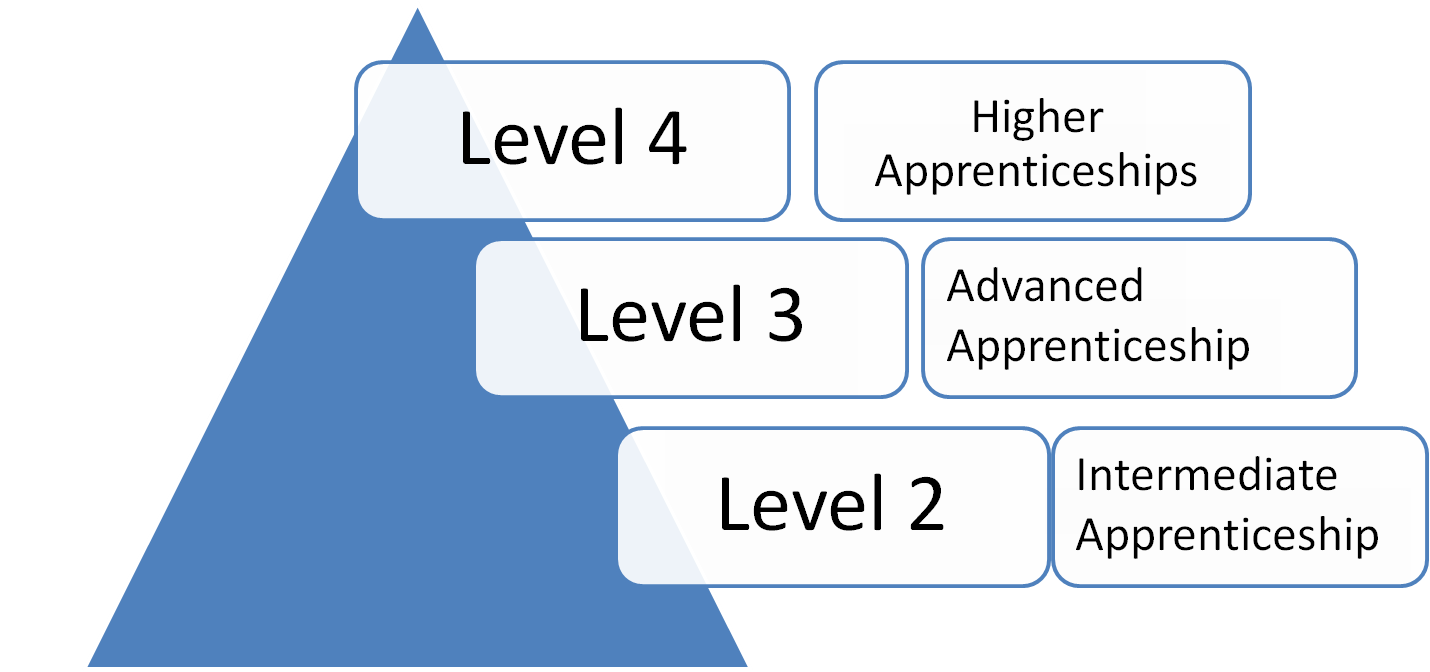
The basic apprenticeship at level 2 is on a par with GCSE levels. In Wales it is called the Foundation Apprenticeship. Typically this will give the learner an insight into the industry and allow them to perform basic routine tasks.
The level 3 Advanced apprentice will already have achieved qualifications or an apprenticeship at level 2 and will learn more in depth knowledge and skills in their industry. When complete they will be the team leaders and typically rise quickly in their chosen industry, compared to those that do not follow an apprenticeship route.
A level 4, Higher Apprenticeship is for those who have level 3 knowledge and skills, possibly some A’ Levels and are looking to become leaders in their industry. They will follow a level 4 program which is equivalent in depth to the 1st year of a university Bachelors Degree course.
It is possible for learners to progress through all the levels. It will take time, patience and hard work but all apprenticeships that are worth doing will require this input.
3-Employer Validation – where the employer signs off that the apprentice has completed all the KSB’s.
Each standard is slightly different in the approach to EPA, some even have an exam that needs to be passed as well as the portfolio.
Assessment
Semester: Learning & Development Ltd deliver learning using the Moodle Learning Management System (LMS). This gives the apprentice a structured approach to learning and access 24/7. The assessment is recorded via the industry standard OneFile e-portfolio. Employers will also have an account so they can access their apprentice’s work and take part in reviews. OneFile is also used to record Off The Job (OJT) Training time and progress.
Each Role also has an Assessment Plan. This details how the evidence will be evaluated and when. Some apprenticeships have a midway gateway, where a certain amount of knowledge(such as level 2 qualification) has to be achieved and agreed with the employer. The apprentice then continues until all the KSB’s have been completed and can progress to the End Point Assessment (EPA).
End Point Assessment
Each apprenticeship has a defined End Point Assessment which will be carried out by a separate company than the training provider. We can source one for you, or use one which you already have a agreement with.
Typically, the EPA will consist of 3 things:
1-Portfolio based validation Interview – this is where the EPA will interview the candidate, the basis of which will be the portfolio of evidence on OneFile.
2-Competence Assessment – this may take the form of a project or task under supervision of the EPA
3-Employer Validation – where the employer signs off that the apprentice has completed all the KSB’s.
Each standard is slightly different in the approach to EPA, some even have an exam that needs to be passed as well as the portfolio.
❓ Frequently Asked Questions
What if I fall behind? We’ll work with you to create a plan that fits your situation.
How do I submit evidence or assignments? Your assessor or tutor will guide you, and we provide templates and examples.
What if I need more time? Extensions and adjustments may be available depending on your circumstances.
How do I contact my assessor or tutor? You can reach them through your learner portal or via email.
📞 Contact & Support
If you need help, advice, or someone to talk to, we’re here.
- Speak to a Learning Adviser
- Request a support call
- Email or phone support
- Live chat (if available)
Finally, remember that reaching out early can make a big difference.
Some of our Apprentice Employers